The Witches of the First Hill
On moonless nights, voices clamour above Famas — voices the city has tried for a century to explain. The skeptics blame the winds. The conspirators blame the dungeons. The mystics speak of witches. Only one of them is right.
By Yaryna
On moonless nights,a shrill clamour of voices could be heard above Famas.
Skeptics blamed the winds. They tangled themselves among the thousand parts that hold the Hills together — slipped into uncapped pipes, jostled poorly fitted stairs — and so such sounds came out.
Conspiracy theorists, amateur detectives and a few rookie policemen claimed the noise rose not from above but from below. The echo between the buildings, they said, only twisted it. The authorities had built secret prisons in the older, deeper dungeons — and there they kept those they had no lawful grounds to lock away in the jail beside the Wild Swamp. Food was dropped down to the cells through pipes, and the same pipes carried strained moans and laughter back to the surface. There is no better place to lose one's mind than imprisonment at great depth — without light, clean air, or fresh food. In the company of other madmen.
Those inclined toward mysticism believed the racket was made by witches holding sabbaths atop the Hills. And on such nights it was better not to leave one's house — neither the old nor the young. But above all, young girls and children.
And these last were right.
Though they did not know that the witches they spoke of had long since been dead. Alive they had been at one single sabbath — the one with which it all began.
This was back when the First Hill was still being raised.
Its frame, not yet gilded, towered over the city, dark and forbidding. On the tiers, the first buildings had only just begun to go up — their unfinished walls gaped with black, uninhabited windows. Only the roads between them were lit by streetlamps, and along those roads, from time to time, the Hill's guards would pass. On every tier they kept a separate post, and made their rounds each hour.
The First was special from the very start — for on one of its central tiers they had walled up a building faster than all the rest. Dark walls. Bars on every window. A high fence crowned with sharp iron spikes.
Samon's private library. Built on that tier to escape excess damp from both earth and sky. The most important place on this Hill, and so it was finished the soonest.
The library was nearly ready; all that remained was to install the shelving and arrange the books, which were already inside. They lay packed in boxes, wound about with chains and locks reinforced with ethereum dust. To touch those locks without the keys, issued by Samon himself, would have been a very great mistake. An irreversible one.
The library kept its own guard, separate from the Hill's. And because private works were still ongoing on the Hill, the lights cut out from time to time — a nuisance no one had learned to be surprised by. So it was that night, too.
It was the hour of the midnight round.
The guards scattered, each toward his own stretch. One of them, a stout ogre named Arnold, was set to inspect several halls and corridors crowded with boxes and partly assembled shelving. He checked one hall, then another — and then the lamps on the ceiling flickered. And went dark.
Finding himself in the blackness, Arnold cursed, spat in vexation, and unhooked the flashlight from his belt. A lone beam pierced the dark. He had worked here for years; the outages did not frighten him. They merely annoyed him.
Step by step — walls, furniture, boxes shackled in iron. The beam roamed over it all, lazy and habitual; he wanted to get back to the room the guards had made their own, where a little supper still remained. Three halls left, two…
And then something long glinted on the floor, like a steel snake. The ogre flinched and dropped the flashlight. His thoughts of supper scattered, giving way to the wild pounding of his heart. It seemed as though someone, somewhere in the dark, had laughed softly.
Arnold snatched up the flashlight and shone it again where he had seen the snake. It was a length of broken chain — it did not glow; it merely reflected the beam off its steel links. He ran the beam along the chain and arrived at a box of books, its lid torn off.
He felt his hair stand on end. If someone had stolen even one of Samon's books…
—“But I didn't steal it. I took it to read.”
Again came the laughter.
The next thing his flashlight lit was a set of shelves already standing in the corner. On its highest shelf, dangling her legs, sat a woman. Young, with long dark hair falling in soft waves over bare shoulders. In her hands she held an open book.
—“Oh, don't worry. I've only a few pages left. Will you wait?”—she said gently
To his own astonishment, Arnold nodded. He stood motionless for twenty minutes, watching as the woman turned the dark pages in the beam of his flashlight, running her eyes across them. When she was finished, she closed the book and listened.
—“They're coming.”—she said
She leapt down from her perch. Arnold didn't have time to fear for her — she settled softly, as though the air had caught her. She laid the closed book on a lower shelf, tossed back her hair, and came up to the guard.
—“Come along, you too. You might be of use to us.”
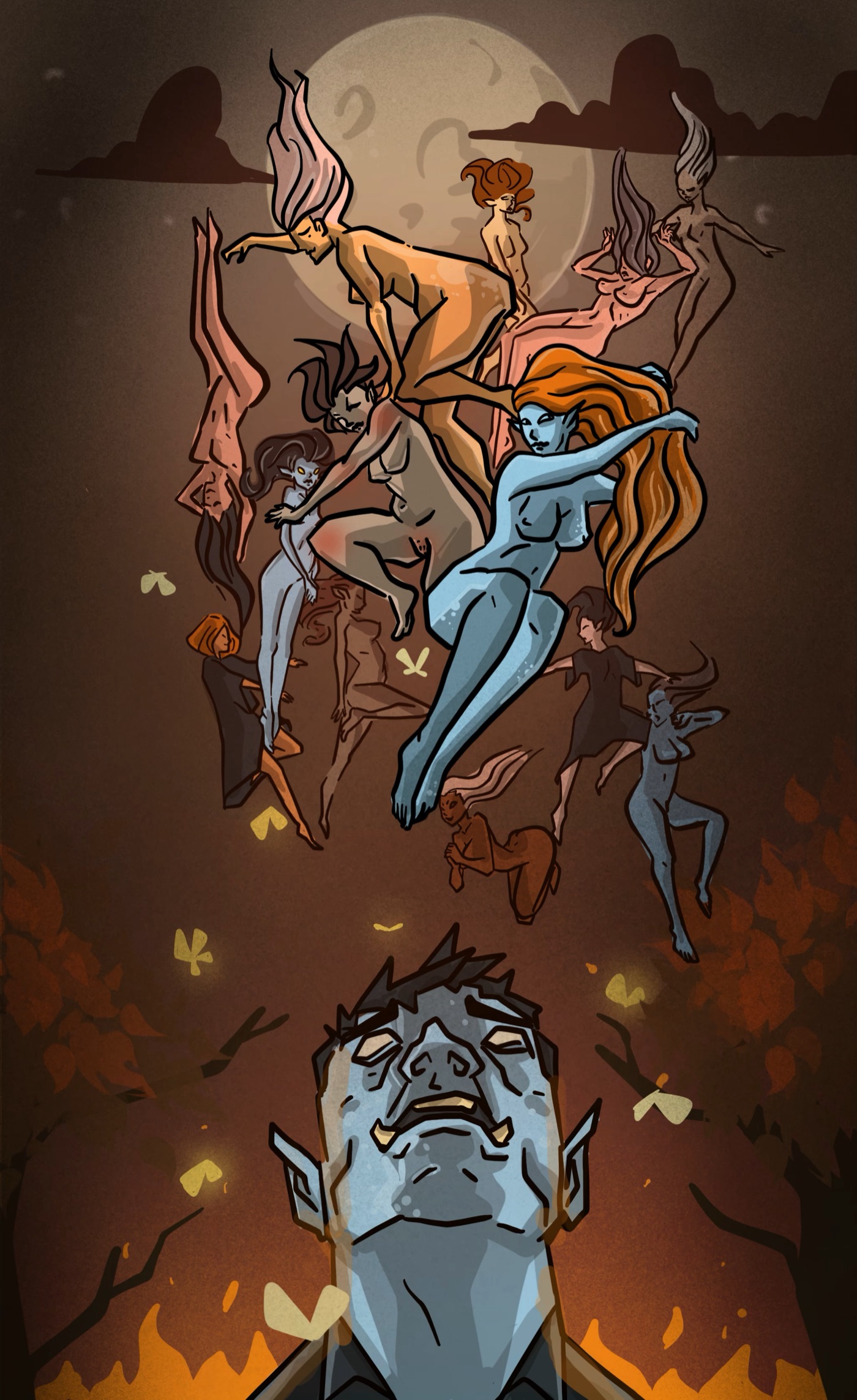
They left the library,passing through the open doors and the gate without meeting any of Arnold's colleagues. He meant to turn aside and check whether his fellow guards had all dropped dead — but he couldn't. The thoughts in his head still seemed his own, yet his body would not obey. His head would not turn where he wished. His legs walked on after the dark-haired stranger without pause.
Out in the street there were no guards either. Instead, there were other women. Some, unclad, greeted one another and headed upward; others walked in silence, glancing about timidly, dressed in long black shifts. Arnold walked on behind his guide. At first he was afraid, then anxious, then gladdened by he knew not what. From watching the women, in time, his thoughts grew as calm and obedient as his body.
They climbed to the roof. Through his sluggish mind flickered a moment of surprise — only a few days before he had been up here and seen nothing but plain grey concrete.
Now upon the roof, besides several dozen women, one could behold a lush garden of trees from which hung beautiful fruit, and several broad bowls of fire that cast their glow upon the strangers.
—“Those without robes — they are my sisters. Witches of renown. The ones in black are the aspirants. Such a choosing comes but once a century; you're lucky to see it, fatso. It's the first time we've gathered in this city — usually we seek out hills and mountains. But it would have been a sin not to dance at such a height.”—murmured his guide
Leaning in, she kissed him on the lips. And then she was lost among the rest.
The ogre remained standing where he was. His feet stuck to the ground; his muscles ceased not only to obey but to feel anything at all — save the heat that came from the bowls.
And the witches began to sing.
First one of them drew out some melody in a ringing voice, then a second, a third. Then they all sang together.
And the sabbath began. With wine — if wine it was — which they drank deep of and doused themselves in. With wild dances and chases, when the figures in the firelight merged so closely that one could not see where one ended and another began. Rings of women, holding hands, spun about the bowls; crossed; collided. They were of all races, all builds and looks — yet all equally bewitching. Fruit was torn loose and thrown into the fire, and then the embers were pulled out and eaten, washed down again with drink.
Arnold, still motionless, felt his own temperature climb whenever a little band of witches ran past him, their damp hair brushing him as they passed. Now and then one of them would kiss him, or rake him with her nails, leaving long red streaks on his cheeks and neck.
They sang, loud and frenzied — until thunder joined their voices, rolling across the wholly black sky.
It went on nearly until dawn. Only then, when it had grown perceptible that the sky was about to lighten, did the rite come to a halt.
The witches dispersed.
Some rose up beside the trees; others lay down on the grass. The aspirants — drunk, dishevelled, no longer frightened in the least — gathered into a long column.
—“And you. Go and stand with them.”
Arnold felt hot fingers close around his wrist. The dark-haired witch from the library led him to the back of the column and set him behind the last of the girls in their shifts. Then she vanished among the trees.
And the column began to move forward, toward the edge of the roof.
The first girl, reaching it, did not stop. After her, the next. And another. They fell soundlessly, fearlessly.
When the sixth went over, a shrill laughter suddenly rose from below — and several figures, already without their shifts, lifted into the sky. They began to fly above the garden and above their new sisters, laughing and delighting in it.
The column kept moving. The girls fell, and rose into the air — but clearly, not all of them.
And then Arnold, too, fell. He managed to glimpse a few black figures flying ahead of him, waving their arms against the light that rose from below, from the distant streetlamps. He managed to feel a few pale bodies rush past him, flying upward.
And he reached the ground.
But he did not shatter. He hung above it, his heavy belly almost touching the bloody mire that remained of those girls who had not had the luck to become witches.
Why he, too, did not shatter — perhaps he had something of the witch in his blood, or perhaps he had simply taken the fancy of that dark-haired witch from the library. Who can say. The ogre did not die. But neither did he return to his former life.
When dawn came,the bloody stains on the asphalt by the Hill soaked into the cracks and vanished without a trace. The witches, old and new, went down into the city — to live there among people, go about their witchcraft, and wait for the next centennial sabbath. And for a long while after that night's rite, the city was — or seemed to be — at peace.
Only on those moonless nights,the bloody stains would crawl out from beneath the asphalt and become girls once more — dressed now not in black shifts, but in crimson shrouds. Again they would climb the First Hill and dance there and make merry, until, before the dawn, they fell once more. Not one of them ever managed to take flight after all. They could only revel and perish, every time.
And the skeptics, and the conspirators, and the mystics all felt the same thing on such nights — better not to leave the house.
And honestly, not without reason. The absence of belief and of fear did not protect anyone from meeting a dark figure that flew parallel to the ground. From time to time it would scrape the asphalt with its great belly, but it never raised its head. With its hands alone it scrabbled along before it, catching those who, it thought, might someday help it finally rise to its feet.
But having caught them, it strangled them…
The End?